.svg)
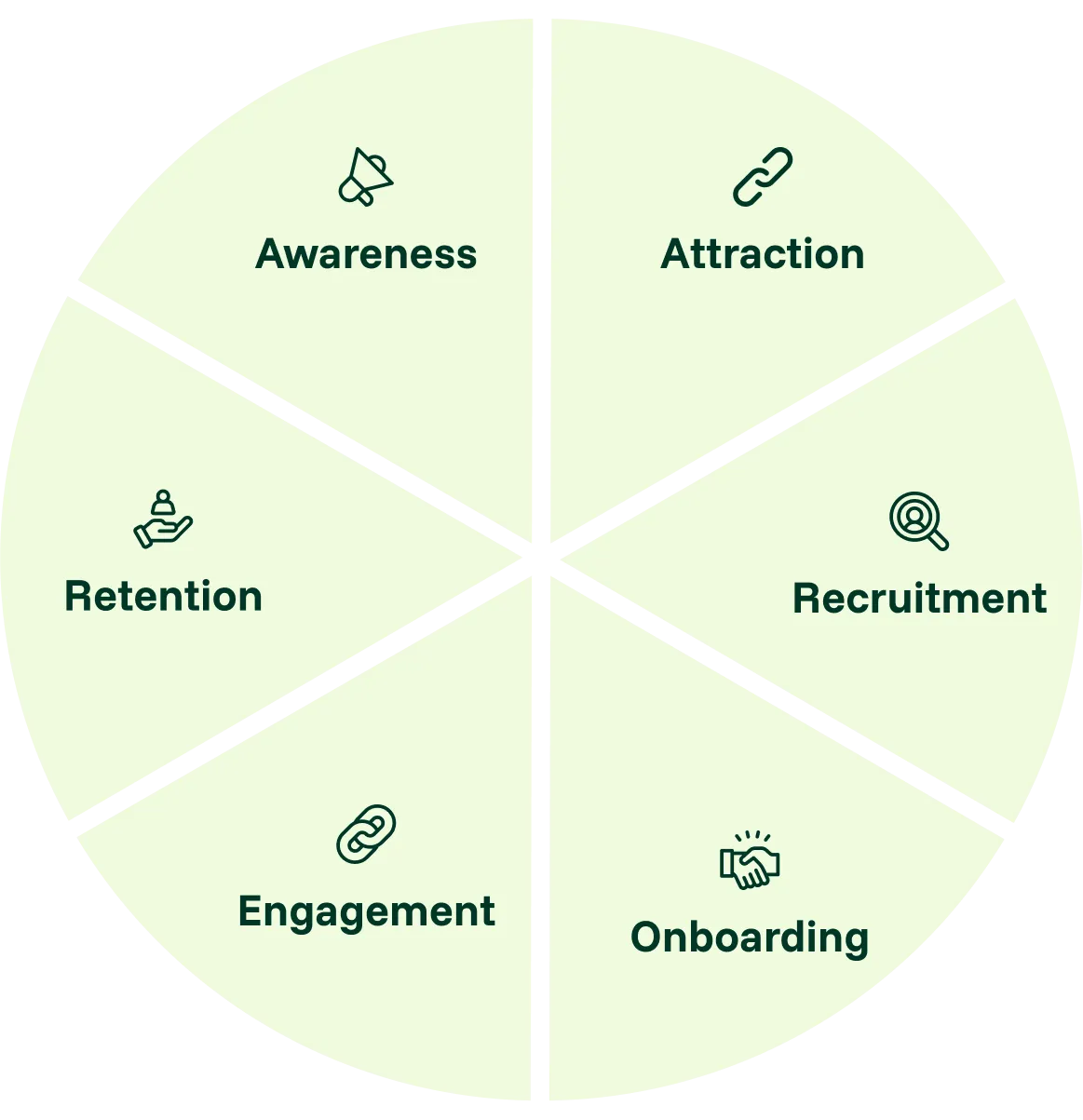
What is it?
Engagement is about creating day-to-day environments where young people feel safe, connected, and motivated to keep showing up.
For many young people, the everyday experience of a place is what tells them whether they belong in it. When questions feel risky, when there's no room to step back, or when their ideas go nowhere, even a motivated young person quietly starts to disengage, long before they ever say so.
Organisations that get this right, ensure that young people feel valued, motivated, and confident to contribute.
Common challenges
What barriers do organisations face at this stage?
The channels organisations rely on, like staff meetings, emails, and rostering systems, often fail to reach young people, especially casual staff. Many organisations describe trying everything from online systems to free lunch and still struggling to reach young people.
Organisations want young people to lead but hesitate to hand over real control, defaulting to supervised involvement instead of genuine ownership. Many organisations describe an instinct to meet young people where they should be rather than where they are, and name this as the biggest mistake institutions make.
Messages delivered by authority figures often don't land, particularly with marginalised communities, and power dynamics can silence young people entirely. Many organisations describe young people weighing who's in the room before deciding whether they can speak at all.
What we heard
Verbatim from Community of Practice members during the Awareness session.
"Staff meetings and email updates don't land with casuals. Even free lunch doesn't work. Rostering is online, but staff won't check the system - we have defaulted to keeping critical messaging all in person."
Community of Practice member
"An authority figure doesn't land with marginalised communities."
Community of Practice member
"The biggest mistake institutions make is that we try to meet people where they should be, not where they are."
Community of Practice member
Guiding insights
What patterns emerged across every organisation we spoke to? Hover or tap any card for the insight behind it.
Young people at this stage are involved, but still deciding whether the experience is worth continuing. Even committed participants can disengage, feel excluded, or withdraw when the conditions stop feeling right.
Continued engagement depends on feeling safe to ask questions, take risks, and share ideas without fear of looking foolish. Young people watch how the first few questions and mistakes are handled before deciding whether to risk their own.
Letting young people manage their own involvement — in tasks, pacing, and participation — reduces stress and builds genuine ownership. Someone who chose their role shows up differently from someone who was assigned it.
Young people contribute most readily on topics they already know, and stretch further once that confidence has been established. Asking for feedback on a campaign they've seen builds the footing to weigh in on projects they haven't, which is why the order of asks matters as much as the asks themselves.
No single mentor or check-in can catch everything, so guidance needs multiple channels: buddies, peers, forums, and open doors. Layers also let supervision fade gradually as independence grows, rather than being removed all at once.
Strategy Playbook
Nine strategies across three themes. Pick a theme, then open any strategy for a worked example.
A visible, predictable presence in the handful of spaces young people already spend time, online and offline, rather than broad coverage nobody notices.
Identify the one platform young people spend time on, and commit your effort instead of choosing every channel.
Find one upcoming event where young people already gather, such as a careers fair, expo, or festival, and offer an interactive activity.
Commit to a publishing schedule you can actually sustain, and hold it long enough for familiarity and trust to build.
Communication that sounds like a person, shows the real work in progress, and lets young people hear about the experience in a peer's voice rather than the organisation's.
Before publishing, read it aloud. Cut any word you would never say in conversation to someone in front of you.
Document the journey of your work, including the challenges, unexpected moments, and how young people have shaped it.
Bring in a young person who already makes content to produce fun, entertaining videos.
A living space young people return to between opportunities, with real ownership over what gets made and shared, so engagement outlasts any single program or post.
Create a moderated space where young people can talk between events, and seed it with content that gives them a reason to return.
Hand a young person or small group control of your social media, with a brief and payment for their time.
Find young people already enthusiastic about your work, and equip them to share opportunities in their own voice.
Reference Panels
Two tables that apply across stages rather than only to Awareness.
Incentives are not only financial. These five types cover what young people told us made an opportunity worth their time. Select one, or compare all five side by side.
Direct payment for time and contribution, through stipends, honorariums, gift cards, or award-wage roles.
It tells young people their expertise has real-world value, and removes one of the most common reasons they say no.
- Provide honorariums or gift cards to value youth time and skills.
- Offer award-wage roles to encourage sustained engagement and responsibility.
- Give flexible micro-grants that youth control to empower ownership.
Tangible professional experience in the opportunity itself, through paid roles, internships, or portfolios.
It gives young people proof of experience they can point to long after the work is done.
- Write reference letters and endorsements to validate contributions.
- Provide paid internships and project roles for real-world experience.
- Support youth to turn their job tasks into a career portfolio that showcases their achievements.
Skill-building and personal growth, through workshops, certifications, or mentoring relationships.
It makes the role valuable in itself, because every shift builds a skill they keep.
- Offer targeted workshops that help youth build new skills.
- Provide online courses and certifications to support continuous learning.
- Pair youth with mentors for guidance, growth, and confidence-building.
- Use reverse mentoring to elevate youth voices in trainings.
Formal acknowledgement of their contribution, through credits, references, or ceremonies.
It tells young people their work mattered and that someone is paying attention.
- Credit youth publicly on publications and social media.
- Host thank you events and award ceremonies.
Access to people and networks, through peer connections, introductions, and projects.
It gives young people a community to belong to and connections that outlast the role.
- Host peer networking events to facilitate connections.
- Connect youth with industry professionals and experts.
- Include youth in real projects to encourage collaboration with professionals.
- Organise community co-creation days to co-design programs.
Direct payment for time and contribution, through stipends, honorariums, gift cards, or award-wage roles.
Tangible professional experience in the opportunity itself, through paid roles, internships, or portfolios.
Skill-building and personal growth, through workshops, certifications, or mentoring relationships.
Formal acknowledgement of their contribution, through credits, references, or ceremonies.
Access to people and networks, through peer connections, introductions, and projects.
It tells young people their expertise has real-world value, and removes one of the most common reasons they say no.
It gives young people proof of experience they can point to long after the work is done.
It makes the role valuable in itself, because every shift builds a skill they keep.
It tells young people their work mattered and that someone is paying attention.
It gives young people a community to belong to and connections that outlast the role.
- Provide honorariums or gift cards to value youth time and skills.
- Offer award-wage roles to encourage sustained engagement and responsibility.
- Give flexible micro-grants that youth control to empower ownership.
- Write reference letters and endorsements to validate contributions.
- Provide paid internships and project roles for real-world experience.
- Support youth to turn their job tasks into a career portfolio that showcases their achievements.
- Offer targeted workshops that help youth build new skills.
- Provide online courses and certifications to support continuous learning.
- Pair youth with mentors for guidance, growth, and confidence-building.
- Use reverse mentoring to elevate youth voices in trainings.
- Credit youth publicly on publications and social media.
- Host thank you events and award ceremonies to celebrate milestones.
- Lead legacy projects or spaces to carry forward youth contributions long-term.
- Host peer networking events to facilitate connections.
- Connect youth with industry professionals and experts.
- Include youth in real projects to encourage collaboration with professionals.
- Organise community co-creation days to co-design programs.
Incentives are not only financial. These five types cover what young people told us made an opportunity worth their time. Select one, or compare all five side by side.
Another young person at a similar stage
Shared experience, encouragement without authority
To feel understood by someone who gets it, and less alone in the struggle
Often, and informal
A friendly colleague, close in age or stage
Answers questions, gives a tour, helps them feel included
To get familiar, slowly settle in, and ask questions without pressure
Daily, in the first weeks
A more experienced colleague, not their manager
Offers advice on handling workplace situations, projects, decisions, and culture
To build their confidence over time and navigate challenges
Periodically, over time
An internal or external coach or supervisor
Helps them reflect, build skills, track progress, and improve in an area of work
To build a particular skill, such as speaking up or leading tasks, or work toward a goal
Scheduled, regular sessions
Another young person at a similar stage
A friendly colleague, close in age or stage
A more experienced colleague who is not their manager
An internal or external coach or supervisor
Shared experience and encouragement, without authority
Answers questions, gives a tour, and helps them feel included
Offers advice on workplace situations, projects, decisions, and organisational culture
Helps them reflect, build skills, track progress, and improve in a specific area of work
When they want to feel understood by someone who gets it and feel less alone in the struggle
When they are getting familiar with a new environment, settling in, and asking questions without pressure
When they want to build confidence over time and navigate challenges
When they want to build a particular skill, such as speaking up or leading tasks, or work towards a specific goal
Often and informally
Daily during the first few weeks
Periodically over time
Scheduled, regular sessions
Ripple Opportunities
SYDNEY // NEW SOUTH WALES
This case study is part of the Youth Engagement Playbook. Download the full playbook to explore all six stages of youth engagement and take the self-assess
In 2013, Good Cycles was founded as Australia's first bike-based social enterprise, breaking down barriers to employment for young people. But its goal is not to hold young people as long as possible, but to move them forward on purpose.
At, Good Cycles they treat the job itself as the intervention, embedding support into paid shifts and everyday work. Each young person joins for a six-month window, and that timeframe gives every month a purpose, because both the young person and the team know the time is building toward what comes next.
Within this, support comes from multiple directions rather than one. Each young person is given a youth employment coach, who meets them regularly on paid time to set goals and work through barriers, always starting from what the young person wants. The third corner is the operational supervisor, who runs the day-to-day work, and the three meet together so that tasks and personal goals never drift apart. This triangle of support means guidance never rests on a single relationship, and it keeps the young person's own goals at the centre of everyday work.
Meanwhile, career progression is mapped as a visible ladder wherever roles allow it. In the gardening team, young people climb from Gardener Level 1 to Level 2 and on to Team Lead. They earn licences and skills at each stage. Because each young person can see the next rung from where they stand, staying becomes a way of climbing.
The ladder doesn't end at the organisation's walls, because Good Cycles builds transition pathways. Around the three-month mark, milestone reviews shift each young person's conversation from settling in to moving on.
Every participant is building towards one of several positive destinations:
- An internal supervisory or ongoing role within the organisation.
- A placement through Good Cycles' commercial relationships and contracts.
- A job in the open labour market, backed by the skills and licences earned inside.
- Further study, or a role with another social enterprise.
These pathways are real because Good Cycles is embedded in a working ecosystem. Its commercial contracts, including work delivered for the City of Melbourne, connect young people to employers who already know the program. Fellow social enterprises like Homie and STREAT have become genuine next steps, with Good Cycles participants moving on to roles within them. Each transition becomes a warm handover to an organisation expecting them, rather than a cold application to a stranger.
Together, this approach redefines retention. Good Cycles doesn't measure success by how long young people stay, but by where they go next. A good exit is treated as a retention outcome, not a failure of it. It proves that the best way to engage young people is to keep moving them forward.
Where do you stand on Engagement?
Now it's your turn. Take an honest look at how your organisation is doing on [stage]. Rate each statement from one to five, and you'll see exactly where to start."
Download The Nine Strategies
A one page summary you can bring to a team meeting, with the worked examples and the self-assessment.
All nine strategies across Channels, Messaging & Community Building
The worked example for each one
The Social Media 101 format table
The seven statement self-assessment, printable